Squishy grass over a leach field indicates hydraulic failure or bio-mat clogging. When an anaerobic bacterial slime layer seals the soil trenches, liquid effluent cannot percolate downward and is forced upward to the lawn surface. If caught early, high-pressure line jetting and resting the field can restore absorption without a full excavation.
In a properly operating drain field, wastewater is discharged through perforated pipes into gravel or chamber trenches. The surrounding unsaturated soil acts as a natural biological filter, purifying the water before it re-enters local groundwater aquifers.
When you step onto your drain field and feel soft, spongy ground—or notice distinct strips of lush, dark green grass accompanied by outdoor sewage odors—the soil underneath has reached 100% liquid saturation.
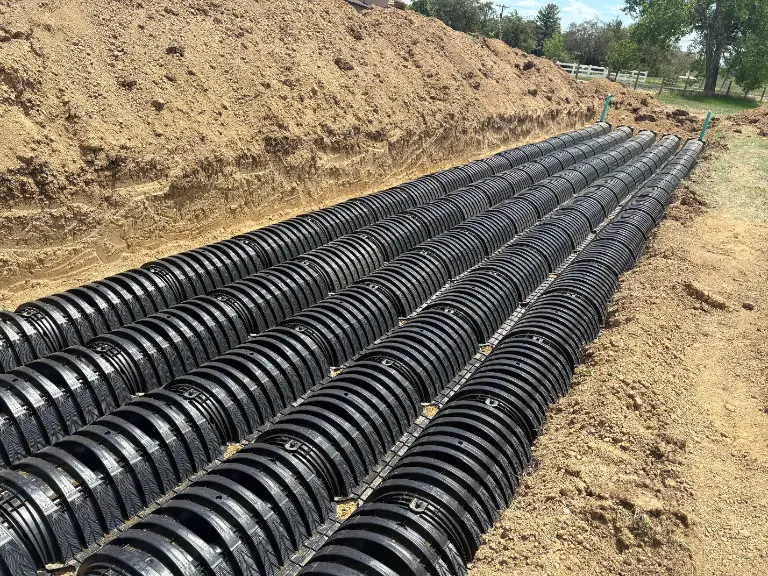
Proper chamber spacing and sand bedding ensure balanced lateral percolation across Colorado soils.
1. What Causes Bio-Mat Clogging?
The primary cause of leach field surfacing is the overgrowth of a biological layer called the bio-mat. The bio-mat consists of anaerobic bacteria, organic solids, and microbial slime that form at the interface between the gravel/chamber trench and natural soil.
A thin bio-mat is normal and helps filter pathogens. However, when a septic tank is not pumped on a 3-to-5 year schedule, solid sludge carryover feeds this bacterial layer, turning it into a dense, waterproof barrier that completely stops downward percolation.
2. Uneven Distribution Box (D-Box) Settlement
In gravity-fed systems, effluent flows from the tank into a distribution box (D-box) that splits liquid equally into multiple lateral runs.
Colorado soils frequently experience ground settlement and frost heave. If the D-box tilts even half an inch, 90% of the wastewater will rush into a single lateral line, overloading that specific trench while the other lines sit empty. Leveling the distribution box and inserting flow adjusters often cures isolated squishy spots immediately.
3. Can a Saturated Drain Field Be Saved?
High-Pressure Hydro-Jetting
We run specialized jetting nozzles through the lateral lines, scouring away bio-mat deposits and flushing out accumulated sludge. Explore our drain field restoration services.
Total System Re-Engineering
If soil structure has experienced total chemical sealing, a new absorption field engineered with Infiltrator chambers must be excavated. Learn about new septic installations.
Frequently Asked Questions
Does squishy grass mean I have to replace my whole drain field?
Not necessarily. If caught before soil compaction occurs, high-pressure line hydro-jetting, biological remediation, and distribution box re-leveling can clear the bio-mat and restore absorption without total re-excavation.
Can I mow over a squishy, saturated leach field?
Avoid running heavy riding lawnmowers over saturated septic areas. Wet soil compacts easily under heavy weight, crushing PVC pipes and permanently sealing subsoil pores.

Suspect Your Drain Field Is Failing?
Austin Bitz diagnoses and restores absorption fields across Weld, Boulder, Larimer, Adams, Arapahoe, and Jefferson Counties. Call 720-883-3390 for an honest diagnostic assessment.